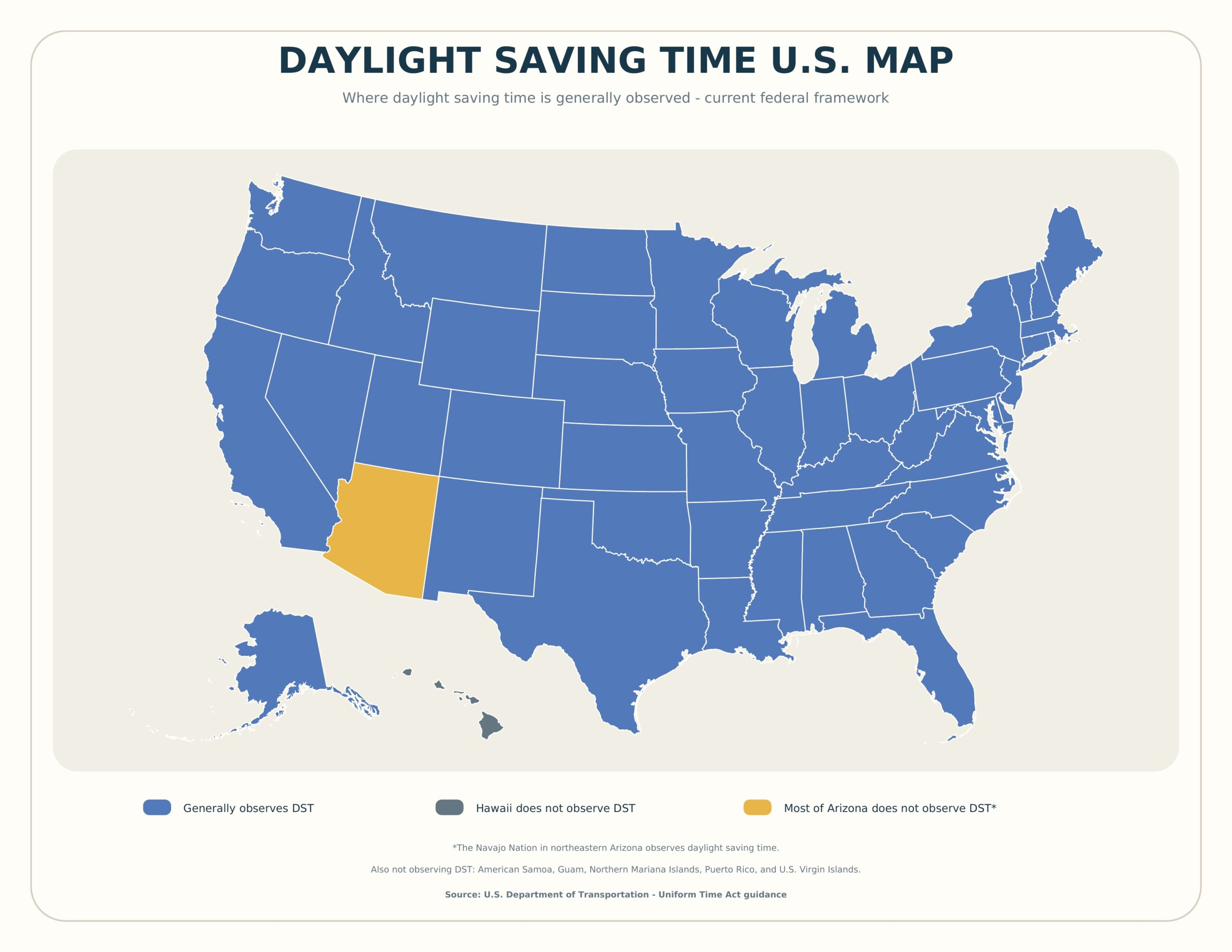
Daylight saving time US map — The printable map below shows where daylight saving time is generally observed in the United States and highlights the principal state-level exceptions. Most states change their clocks seasonally, while Hawaii and most of Arizona remain on standard time throughout the year.
The U.S. Department of Transportation oversees the federal daylight saving time framework. States may exempt themselves from observing DST under state law, but a state that chooses to participate must follow the federally established start and end dates.
Download the Printable PDF Map
Download the High-Resolution JPG
Which U.S. States Observe Daylight Saving Time?
Most of the United States observes daylight saving time. Participating locations move clocks forward by one hour in spring and return to standard time in fall. The change affects local civil time, but it does not change the underlying time-zone boundary.
Under current federal rules, DST begins on the second Sunday in March and ends on the first Sunday in November. In 2026, clocks moved forward on March 8 and are scheduled to move back on November 1.
Which States Do Not Observe Daylight Saving Time?
Hawaii
Hawaii does not observe daylight saving time. Its clocks remain on Hawaii-Aleutian Standard Time throughout the year. Its tropical latitude means seasonal daylight variation is smaller than in much of the continental United States.
Most of Arizona
Most of Arizona does not observe daylight saving time and remains on Mountain Standard Time year-round. During the DST portion of the year, most of Arizona has the same clock time as Pacific Daylight Time.
Navajo Nation Exception
The Navajo Nation observes daylight saving time. Because Navajo Nation lands extend across Arizona, New Mexico, and Utah, this creates a well-known exception inside Arizona. Travelers should verify the local time when crossing reservation boundaries.
U.S. Territories That Do Not Observe DST
The U.S. Department of Transportation states that American Samoa, Guam, the Northern Mariana Islands, Puerto Rico, and the U.S. Virgin Islands do not observe daylight saving time. These territories are listed in the printable notes even though they are not all displayed at the scale of the main 50-state map.
How to Read the Map
- Blue states: Generally observe daylight saving time.
- Gray Hawaii: Does not observe DST.
- Gold Arizona: Most of the state does not observe DST.
- Arizona asterisk: Reminds readers that the Navajo Nation observes DST.
The map describes the general legal framework. It is not intended to resolve every local boundary question, business schedule, transportation timetable, or device-setting issue.
Why Does the United States Use Daylight Saving Time?
Daylight saving time shifts an hour of daylight from the morning toward the evening during the warmer portion of the year. Supporters and critics debate its effects on energy use, transportation, health, commerce, recreation, and daily schedules. Regardless of those debates, the legally controlling question is whether current federal and state rules require a location to observe it.
Daylight Saving Time vs. Standard Time
Standard time is the base civil time assigned to a time zone. Daylight saving time is the seasonal one-hour adjustment used by participating locations. For example, Eastern Standard Time is UTC-5, while Eastern Daylight Time is UTC-4. The abbreviations EST and EDT are therefore not interchangeable.
U.S. Time Zones and DST
Daylight saving time does not create a new geographic time zone. It changes the UTC offset used within participating areas. Eastern, Central, Mountain, Pacific, Alaska, and parts of the Hawaii-Aleutian system have different relationships to DST. Arizona’s year-round Mountain Standard Time and Hawaii’s year-round standard time are the most prominent state-level exceptions.
How to Print the U.S. DST Map
- Download and open the PDF.
- Select US Letter paper.
- Choose landscape orientation.
- Select “Fit” or “Fit to printable area.”
- Print in color to preserve the legend categories.
Frequently Asked Questions
Does Arizona observe daylight saving time?
Most of Arizona does not observe DST. The Navajo Nation is the major exception and does observe the seasonal clock change.
Does Hawaii change its clocks?
No. Hawaii remains on standard time year-round.
Do all other states observe DST?
Under the current statewide framework, the other 48 states generally observe DST. Local tribal and boundary details can create practical exceptions that should be checked when exact time is important.
Can a state remain on daylight time permanently?
Under the current federal framework, states can exempt themselves and remain on standard time, but permanent daylight time requires a change in federal law or federal authorization.
When do clocks change in 2026?
In participating U.S. locations, DST began March 8, 2026, and ends November 1, 2026.
Official Source
This map follows the U.S. Department of Transportation daylight saving time guidance and the federal framework established under the Uniform Time Act. Check official guidance when legislation or local rules change.